
Let’s start with something I say to clients all the time—and yes, I stand by it:
You can have the most beautiful website in the world, but if your words don’t work, your website won’t either.
As the owner of Sarah McKenzie Copywriting & Web Design, my most popular service to date has been website content writing. And for good reason. Over the years, I’ve built a reputation for writing website copy that’s not only informative, but actually engaging—and that’s not always an easy balance to strike. More importantly, it performs. It ranks. It converts.
In fact, my own website went from position #74 to #4 on Google in less than a month. No Google ads. No shortcuts. Just highly optimized, strategic website copy doing exactly what it’s supposed to do.
And yet, I still hear the same things over and over again. Clients tell me they don’t have the time to write their website copy. Or they don’t feel confident in their writing. Or my personal favourite—they can write for everyone else, but not for themselves. (I’m looking at you, marketing agencies!)
Sometimes, they simply don’t realize how important copywriting for websites actually is.
So, let’s talk about it.
What Is Website Copywriting (and Why It’s More Than Just “Writing”)
Website copywriting isn’t just about filling pages with words. It’s about communicating clearly, strategically, and persuasively with the people you want to reach.
When done well, it guides your visitor through a very intentional journey. It answers their questions before they even ask them. It builds trust quickly. And ultimately, it moves them toward taking action—whether that’s booking a consultation, making a purchase, or reaching out.
That’s why learning how to write website copy properly is so important. It’s not just about sounding professional. It’s about being understood.
Because if your audience doesn’t understand what you do, they won’t stick around long enough to care.

Does Good Website Copy Really Matter?
Short answer? Yes.
Longer answer? It matters more than most people think.
I’ve worked with clients who came to me after investing heavily in design. Their website looked incredible—but it wasn’t performing. Traffic was low. Conversions were even lower. And they couldn’t figure out why.
Almost every time, the issue came down to the same thing: the messaging wasn’t clear.
Design might get someone’s attention, but copy is what keeps them there. It’s what explains your value, builds credibility, and gives people a reason to trust you.
Without strong copy, your website becomes a missed opportunity.
And that’s why I always say: strong copywriting is more important than great design. A great design can enhance your message—but it can’t replace it.
The Pages Every Website Needs (and What They Should Actually Say)
When I’m working on copywriting for websites, I always start by looking at structure. Because even the best writing won’t work if it’s not in the right place.
Home Page
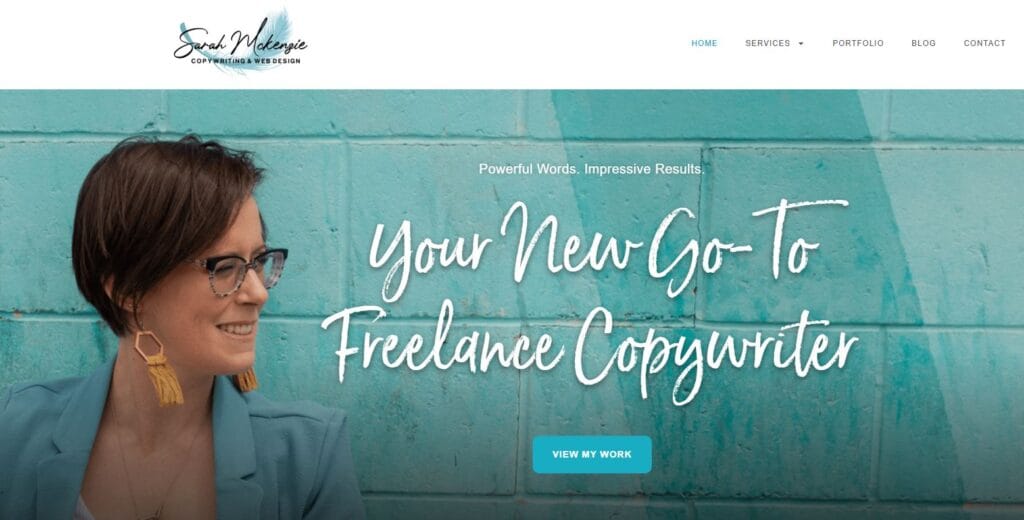
Your home page is where everything begins. This is your first impression, and it needs to be immediate. Within seconds, your visitor should understand exactly what you do and who you help. On my own website, for example, I lead with a clear statement—“Your New Go-To Freelance Copywriter”—and then I immediately speak to both of my target audiences: marketing agencies and brands. That level of clarity helps people quickly identify whether they’re in the right place.
About Page
Your About page is often the second most-visited page on your site, and it plays a huge role in building trust. This is where people go when they’re considering working with you. They want to understand who you are, what your experience is, and why you do what you do. This isn’t the place for a generic bio—it’s an opportunity to connect.
Services Page
Your Services page needs to be incredibly clear. This is where many businesses lose potential clients by being too vague or too complicated. Your job here is to explain exactly what you offer, who it’s for, and what kind of results people can expect. If someone finishes reading your Services page and still has questions, something needs to be clarified.
Blog Page
Your blog is where your long-term visibility comes from. It’s one of the most powerful tools you have for SEO, AEO, and GEO. Every blog post is an opportunity to show up in search results for terms like how to write website copy, web copywriting tips, or tips for writing website content. Over time, this builds authority and brings consistent, organic traffic to your site.
Contact Page
And finally, your Contact page should be simple and straightforward. If someone is ready to reach out, don’t make them work for it. The process should feel easy and intuitive.
The Benefits of Great Copywriting for Websites
Strong website copy does a lot more than just “sound good.” It plays a direct role in how your business is perceived and how it performs.
First, it helps build your brand identity. The way you write communicates your personality, your tone, and your values. Whether you’re more conversational or more formal, more bold or more reserved, your copy sets the tone for how people experience your brand.
Second, it improves your visibility. When your content is optimized properly, it helps your website rank higher in search results. That includes traditional SEO, as well as AEO (Answer Engine Optimization) and GEO (Generative Engine Optimization), which are becoming increasingly important as search evolves.
And most importantly, it drives sales.
When your messaging is clear, your value is obvious, and your content is easy to understand, people are far more likely to take action. That’s the ultimate goal of good copywriting for websites.
How to Write Website Copy That Actually Works
If you’re trying to figure out how to write good website copy, there are a few foundational principles that make all the difference.
It starts with understanding your audience. You need to know who you’re speaking to—and just as importantly, how they think. One of the biggest mistakes I see is businesses using overly technical language that their audience doesn’t relate to.
I recently worked with a medspa client who had this exact issue. Their previous copy included highly technical terms that the average person wouldn’t understand. I explained that while those terms might be accurate, they weren’t helpful. Most people don’t know what a “neurotransmitter” is in that context—but they do know what Botox is. So we simplified the language, made it more relatable, and the messaging instantly became more effective.
Another key principle is focusing on benefits rather than features. It’s not enough to describe what you offer—you need to explain how it helps. What problem does it solve? What outcome does it create? I spend a lot of time speaking directly to my clients’ pain points, whether that’s a lack of time, a lack of writing confidence, or simply not knowing where to start.
Clear calls-to-action are also essential. Your reader shouldn’t have to guess what to do next. Whether it’s booking a consultation or reaching out for more information, guide them toward that next step.
And of course, your writing should be clear, concise, and easy to read. Online content needs to be scannable. That means shorter paragraphs, logical flow, and clean formatting. At the same time, it should still feel natural and engaging.
Finally, don’t forget about optimization. If you want your content to perform, it needs to be structured in a way that search engines—and now AI tools—can understand. That’s where keywords like copywriting for websites, how to write website copy, and tips for writing website copy come into play.

Tools I Use to Write High-Performing Website Copy
Over the years, I’ve refined a toolkit that helps me write more effectively and strategically:
- Grammarly: A staple for polishing grammar and improving clarity. It’s especially useful for catching small errors that can impact professionalism.
- UberSuggest: A straightforward, reliable keyword research tool that helps identify opportunities and guide content strategy.
- Google Search Console: Track how content is performing once it’s live and receive valuable insight into what’s working and where there’s room to improve.
And yes, I use AI tools as well—but always with a strategic, human-led approach. AI can support the process, but it can’t replace the thinking, experience, and nuance that strong copywriting requires.
Conclusion: Your Copy Is Your Competitive Advantage
If there’s one thing I hope you take away from this, it’s this: Your website copy is not something to rush or overlook. It’s one of the most important investments you can make in your business.
Because at the end of the day, your website isn’t just there to look good. It’s there to work for you.
And when your copy is done right, it does exactly that.
Ready for Website Copy That Actually Works?
If you’ve made it this far, you already understand something most businesses don’t: Your website isn’t just a digital presence—it’s a conversion tool. And your copy is what makes it work.
But knowing how to write website copy and actually doing it well are two very different things.
That’s where I come in.
As the owner of Sarah McKenzie Copywriting & Web Design, I specialize in writing website copy that’s not only clear and engaging but strategically built to rank, resonate, and convert. Whether you’re starting from scratch or refreshing an existing site, I help turn your messaging into something that works for your business, not against it.
Because the reality is, most of my clients come to me for the same reasons:
- They don’t have the time,
- They don’t feel confident in their writing, or
- They know their website isn’t performing the way it should—but they’re not sure why.

If that sounds familiar, you’re not alone.
And you don’t have to figure it out on your own, either. If you’re ready for website copy that:
- Attracts the right audience,
- Keeps them engaged, and
- Actually drives results.
Let’s talk. Or, if you’re still exploring your options, feel free to reach out—I’m always happy to point you in the right direction.
At the end of the day, your words should be working just as hard as you are.
FAQs
What are some tips for writing website copy?
Start by getting crystal clear on your audience—who they are, what they care about, and what problem they need solved. From there, focus on clarity over cleverness. Your message should be easy to understand at a glance, with strong headlines that immediately communicate value.
Keep your sentences concise, use active voice, and break up content with short paragraphs for readability. It’s also important to incorporate relevant keywords naturally to support SEO, without sacrificing flow.
Finally, always guide your reader with a clear call to action (CTA) so they know exactly what to do next.
How do I write good website copy?
Good website copy is rooted in strategy, not just writing. Begin with research—understand your audience, competitors, and search intent. Then, structure your content so it flows logically, leading the reader from interest to action.
Focus on benefits over features, showing how your product or service improves the reader’s life or business. Maintain a consistent brand voice throughout, and write in a way that feels natural and engaging.
Once your draft is complete, edit ruthlessly—tighten your language, remove fluff, and ensure every word serves a purpose. The goal is simple: clear, compelling copy that converts.